AI, Complex Decision-Making and the Future of the Legal Profession: Introducing a New Harvard Series
This week David Wilkins and I launched a project we have been developing for months at the Harvard Law School Center on the Legal Profession: AI, Complex Decision-Making and the Future of the Legal Profession. The first four essays and an interactive topic network of our 170-source evidence base are live, with a full series, a Harvard Law seminar in Fall 2026, and continuing engagement with senior leaders across the year ahead.
I want to walk you through what is there.
The premise is that AI is not just another technology being adopted by lawyers. It is structurally reconfiguring how legal services are delivered, who delivers them, how lawyers are trained, and what it means to exercise professional judgment. That kind of transformation cannot be tracked from a single vantage point. It needs the dragonfly's compound eye — multiple lenses held at once, integrated into one view.
David has studied the legal profession as a system for decades — who enters it, how careers unfold, how firms make money, how the field globalises and transforms. I work on complex decision-making and have built AI tools for multi-lens analysis across risk, strategy, and policy. One of us reads the professional structure. The other reads the technology strategy. Together we see things neither of us sees alone.
This is an academic project, but one with an unusual method. We are using the Dragonfly Thinking agents I built to help analyse and visualise the system the project is studying. Some of those agents encode frameworks that originated in my academic work. In this project, we are paying it back — using Dragonfly tools to extend academic work on a field that is reconfiguring faster than any one mind, even a pair of expert minds, can track alone.
Here is what is live this week.
Series Introduction: AI, Complex Decision-Making and the Future of the Legal Profession
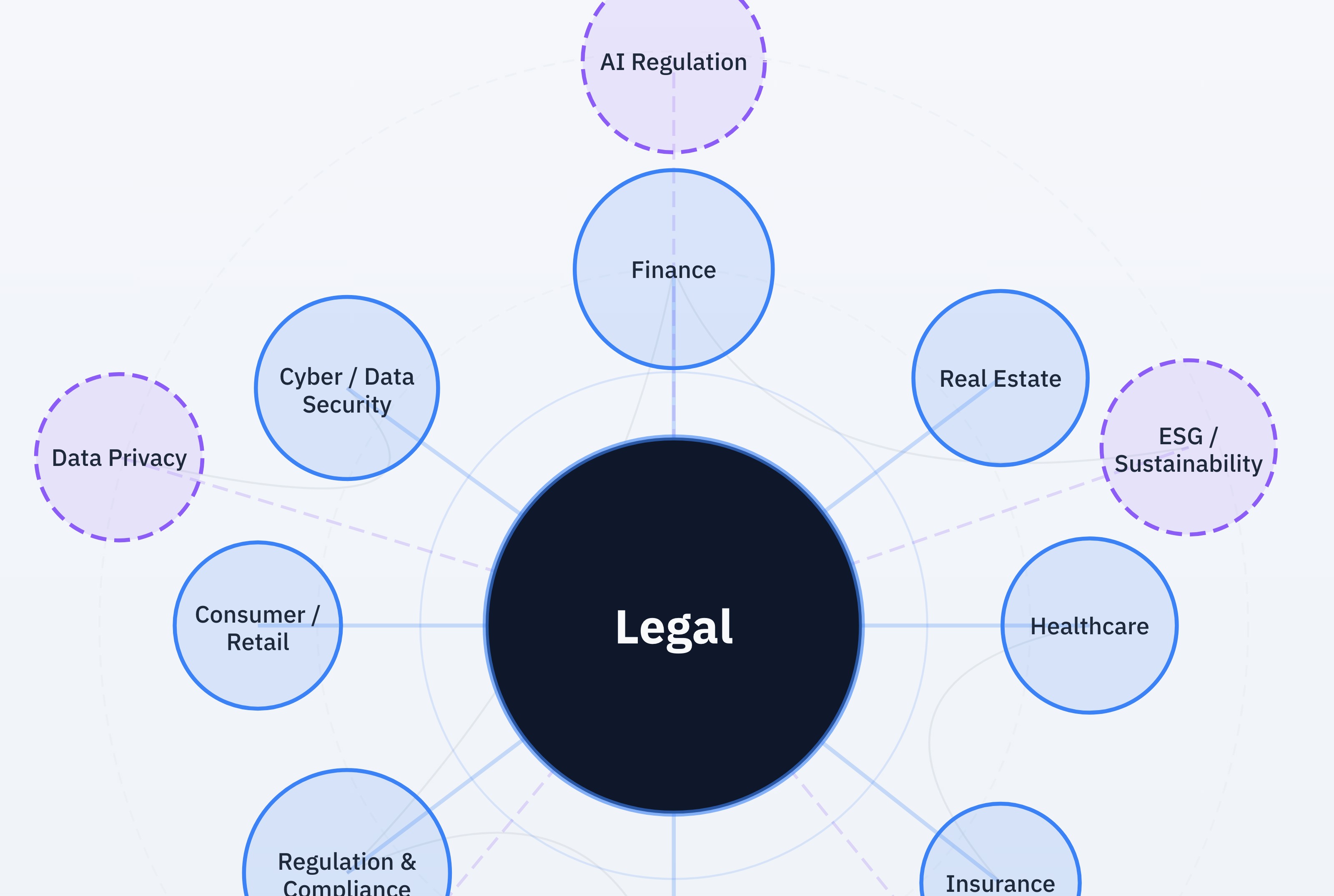
View directly: hlsclp.org/visualisations/topic-network.html
The introduction sets out why the project exists, what each co-author brings to it, and how AI, complex decision-making, and the structure of the legal profession intersect. It frames the multi-lens approach that runs through the series and introduces the topic-network map. If you want one piece to start with, start here.
Law Is the Gateway Drug
View directly: hlsclp.org/visualisations/law-gateway-systems.html
David is the lead author on this one. His structural reading: Harvey, the most prominent legal AI company, is valued at roughly ten times the largest accounting AI company. No standalone consulting AI company exists at meaningful scale. The "AI is good at legal text" answer cannot account for the gap. Lawyers have spent a century quietly engineering law into the central node of business and governance — the gating input the deal cannot close without, the opinion letter that functions as capital-markets currency, the gatekeeper role for issues from sustainability to AI itself. An AI system trusted in legal contexts does not just gain access to legal work. It gains access to everything law touches.
Harvey's Strategic Evolution
View directly: hlsclp.org/visualisations/harveys-strategic-evolution.html
The most-discussed legal AI company is usually read as an overvalued ChatGPT wrapper. We read it differently. Harvey is not building a product. It is building five concentric rings, and each ring absorbs the previous one. Winston Weinberg and Gabe Pereyra didn't take the standard startup advice — pick a narrow legal use case, do it brilliantly. They took the bet that "the models are the product" and built for breadth. If law is the gateway drug for AI across professional services, Harvey is the most legible attempt yet to occupy the gateway as infrastructure rather than as a tool. Whether the strategy works is a separate question, and the essay has a section on adoption headwinds. But the strategy is a real strategy, not a chatbot at an inflated valuation.
Getting Your Hands Dirty
View directly: hlsclp.org/visualisations/director-coach-editor.html
This piece describes me sitting with David and showing him how I actually work with our agents — context engineering as well as prompt engineering, dictating thoughts through Wispr Flow to open the conversation, directing agents to undertake different types of analysis, reviewing their outputs against decades of professional judgment David brings, and co-creating essays and interactive visuals. The Greeks had a word for this kind of knowledge: metis — practical wisdom, as distinct from theoretical knowledge. You don't get metis from textbooks. You get it from doing.
What being an author in this project confirmed for me, beyond the substance of the legal questions, was that: domain experts directing AI well is the bottleneck, not raw model capability. Context engineering is at least as important as prompt engineering. Metis transfers between people sitting together — not from reports or two-day workshops. And an agent surfacing a connection neither human had seen ("the difference between a gateway and a gateway drug") is real value, not a parlour trick — but only when paired with the judgment to tell the brilliant connection from the plausible nonsense.
This is the first wave. The full series will continue across 2026, alongside the seminar David and I will co-teach at Harvard Law School in Fall 2026 and continuing engagement with senior leaders across the year. This work builds on a 2024 senior leadership workshop we co-led at Harvard with chief legal officers from Blackstone, Vanguard, BlackRock and AIG, and managing partners from Morgan Lewis, Orrick and McGuireWoods.
We are not writing about AI from the outside. We are living it from the inside as it reconfigures our field and how we approach our research projects.
We are sharing the pieces as they emerge — not as finished pronouncements but as lenses being tested and refined. If you have a perspective the four opening pieces miss, or a sector where the structural reading lands differently, we want to hear about it.
Read more: project home · essay series · topic network · HLS Fall 2026 seminar
© Anthea Roberts, 2026
Stay informed
Where AI meets strategic thinking.
New analysis on AI, strategy, and the intersection of both — from the team building tools to make better decisions, not just faster ones.