Learned Agency vs Learned Helplessness
By Anthea Roberts and Miranda Forsyth
Date: April 2026
We co-founded Dragonfly Thinking together. Neither of us had a background in technology — we're both professors at ANU in law, regulation and governance. But building an AI-enabled platform has meant learning a lot of AI along the way. Last week's newsletter introduced a concept we've been thinking about: learning agency — the disposition to run two processes at once, producing the output AND learning from the production. This week, something happened between the two of us that brought the concept to life — and revealed a deeper one.
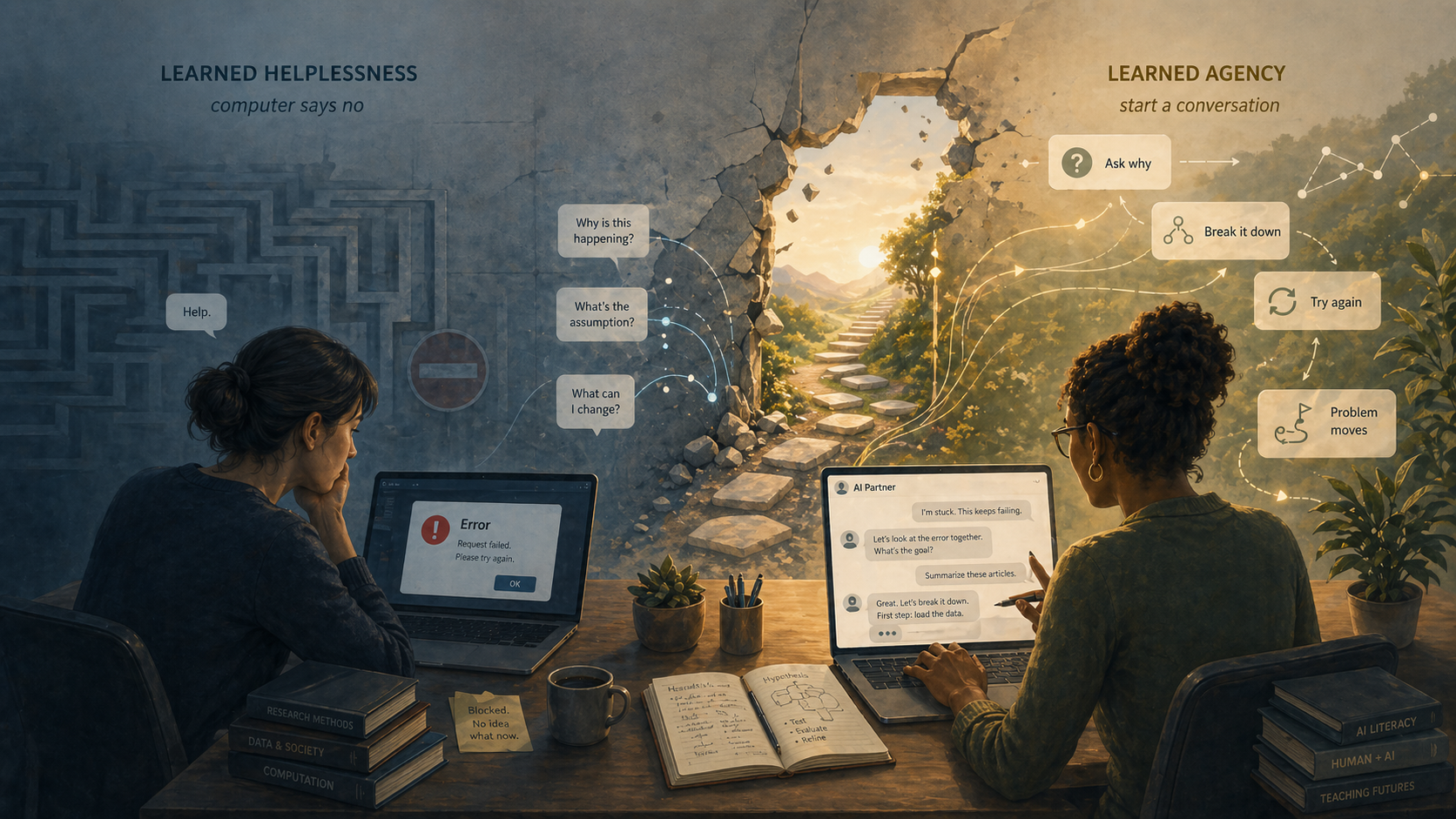
Most non-technical people have spent decades learning that when the computer says no, you stop. The psychologist Martin Seligman called this learned helplessness — the passivity that sets in when your actions repeatedly don't change outcomes. This week, we lived it between us. And then we learned our way out of it.
The morning I was drafting last week's newsletter on learning agency, I called Miranda to talk through the idea. The concept had been forming as I watched how different people responded to AI tools. Some used them to shortcut understanding. Others used them to accelerate learning. And the difference wasn't talent or technical background — it was disposition. Miranda liked the concept immediately. It applied to both of us. We'd both gone from domain expertise to learning AI — not through formal training, but through doing. Through building Dragonfly, breaking things, asking questions, trying again.
That same day, Miranda was applying some of the new Dragonfly agents and skills to her own academic work. I'd walked her through it earlier — which prompt to use, which files to point to, how to ask for the process to be done. Two hours later, I got a message.
It simply said: Help.
Followed by an error message: API Error: Claude's response exceeded the 32000 output token maximum.
I let out a sigh. Miranda, did we not just have a whole conversation this morning about learning agency?
I knew what the message meant and what to do about it because I had seen that message before. But how did I know? Here is what I do when I get an error message like that — and I get them all the time. I screenshot the error, put it into Claude, and ask: what does this mean? What else can we do? How else can I achieve my goal?
I am not a software engineer. But I've used this approach to accomplish things that would previously have been completely outside my reach — complex analytical tools, development environments, deployment pipelines. Not because I suddenly understood all of the technical details, but because I learned that things don't stop when the computer says no. You just have to ask more questions and try more workarounds. And in the process, I've learned an awful lot about software engineering.
Miranda's response to the error message was different. And that made me realise that, for most non-technical people, the default relationship with computers has been one of learned helplessness.
When I called Miranda back, I didn't just explain what I thought she should do. I explained what I thought the underlying problem was — the token limit was too low for the output being requested — and how I would respond to it by breaking up the task into smaller parts so that Claude could complete individual tasks under the limit. But the bigger point I made was that she shouldn't be asking me; she should be asking Claude.
To be fair — and this is Miranda here — important context for understanding this situation was that at the time of the query arising, I had been following agents designed by, and described to me by, Anthea. I was therefore oriented towards learning from Anthea, rather than the machine. I was also fitting that task in amongst many others that morning. Learning agency requires bandwidth, not just disposition. It's very hard to open yourself to new learning when you feel you have absolutely no time for exploration and trial and error.
Nevertheless, I took Anthea's point. She is not always around to answer my queries, and I am increasingly realizing that Claude is. I leant into this "so, what do we do about this problem, Claude?" mindset. When I took it back to Claude and asked, Claude diagnosed the same problem and suggested the same fix. You can ask a friend, and you can ask Claude. I learned how to fix that problem. But the bigger lesson was that it was a reminder to exercise agency — to learn from the computer, not just to be stopped by it.
A few days later I called Anthea to say that I had created a new tool all by myself, without needing her to answer a single question.
Seligman coined the term learned helplessness in 1967 after experiments showing that animals exposed to inescapable shocks eventually stopped trying to escape — even when escape became possible. They had learned that their actions didn't matter. Seligman used this to explain depression in humans: repeated exposure to uncontrollable events teaches passivity.
But fifty years later, Seligman and his colleague Steven Maier revisited the theory with new neuroscience and concluded they had it backwards. Passivity, it turns out, is the default neurological response to prolonged aversive events. It doesn't need to be learned. What does need to be learned — actively, through experience — is control. The brain has to develop the circuit that detects contingency: the connection between "I did something" and "something changed." Without that experience, passivity persists. Not because it was taught, but because it was never overridden.
Think about what decades of computing did to non-technical users. Opaque error messages with no explanation. Interfaces designed for engineers. No way to ask "why?" When something went wrong, you couldn't reason about it, couldn't ask the machine what happened, couldn't try alternatives. The error was a wall. You accepted it and called someone who knew more than you did. Or you gave up. We both recognise this in ourselves. We didn't learn to be passive around computers. We simply never had the experience of contingency that would have built the alternative. We never developed the circuit that says: I asked, it answered, the problem moved.
AI changes this — but only if you ask. It doesn't automatically rescue you from the wall. It creates the possibility of a conversation with the error. You can ask why. You can ask what to do next. You can try something different and see what happens. The wall becomes a conversation starter rather than a full stop. But you have to be the one who starts the conversation.
This is what last week's newsletter argued: learning agency is an action, not a belief. Miranda's shift wasn't from incompetence to competence — she was always competent. It was from accepting "computer says no" as a full stop to treating it as a conversation starter that could be had, with no other human required.
In Miranda's case, she had experienced the contingency — asked the machine a question, received an answer she could act on, watched the problem move — and that experience rewired her default response. The next time she hit a wall, she didn't stop. She started asking.
Seligman's revised theory suggests that passivity is where we all begin. Control — the sense that your actions can change outcomes — is the thing that has to be learned. And it's learned through the experience of contingency: doing something, seeing it work, and doing it again.
We're both still learning. Anthea hits walls constantly and asks questions constantly. Miranda now does the same. The difference between us was never ability (ha ha, Miranda begs to differ here) — it was how many times we'd already experienced the contingency. How many times we'd already asked the machine a question and watched the problem move.
So when you hit the next error, the next wall, the next "computer says no" — do you stop? Or do you start a conversation?
References
- Anthea Roberts, "Learning Agency: Two Processes, Not Just One," Dragonfly Thinking Journal, April 2026.
- Martin E.P. Seligman and Steven F. Maier, "Failure to Escape Traumatic Shock," Journal of Experimental Psychology 74, no. 1 (1967): 1–9.
- Steven F. Maier and Martin E.P. Seligman, "Learned Helplessness at Fifty: Insights from Neuroscience," Psychological Review 123, no. 4 (2016): 349–367.
© Anthea Roberts, 2026
Stay informed
Where AI meets strategic thinking.
New analysis on AI, strategy, and the intersection of both — from the team building tools to make better decisions, not just faster ones.