Diamond-Complete: The Shape of Work That Compounds with AI
The most useful way we've found to think about who AI helps and who it quietly displaces isn't job titles, or industries, or seniority. It's shapes. The shape of a person's expertise — how deep it runs, how wide it reaches — predicts, better than almost anything else, whether AI compounds your value or erodes it. So before any of the analysis, it's worth being clear about the shapes themselves: what they are, how they fared before AI, and what AI has done to each. The rest builds from there.
The shapes
Start with two strokes. A vertical one for depth: a domain you genuinely know, the thing you trained in and have practised for years. A horizontal one for breadth: how many other fields you can reach into and work across. Almost everyone is some combination of the two, and for a long time three shapes were the ones that mattered.
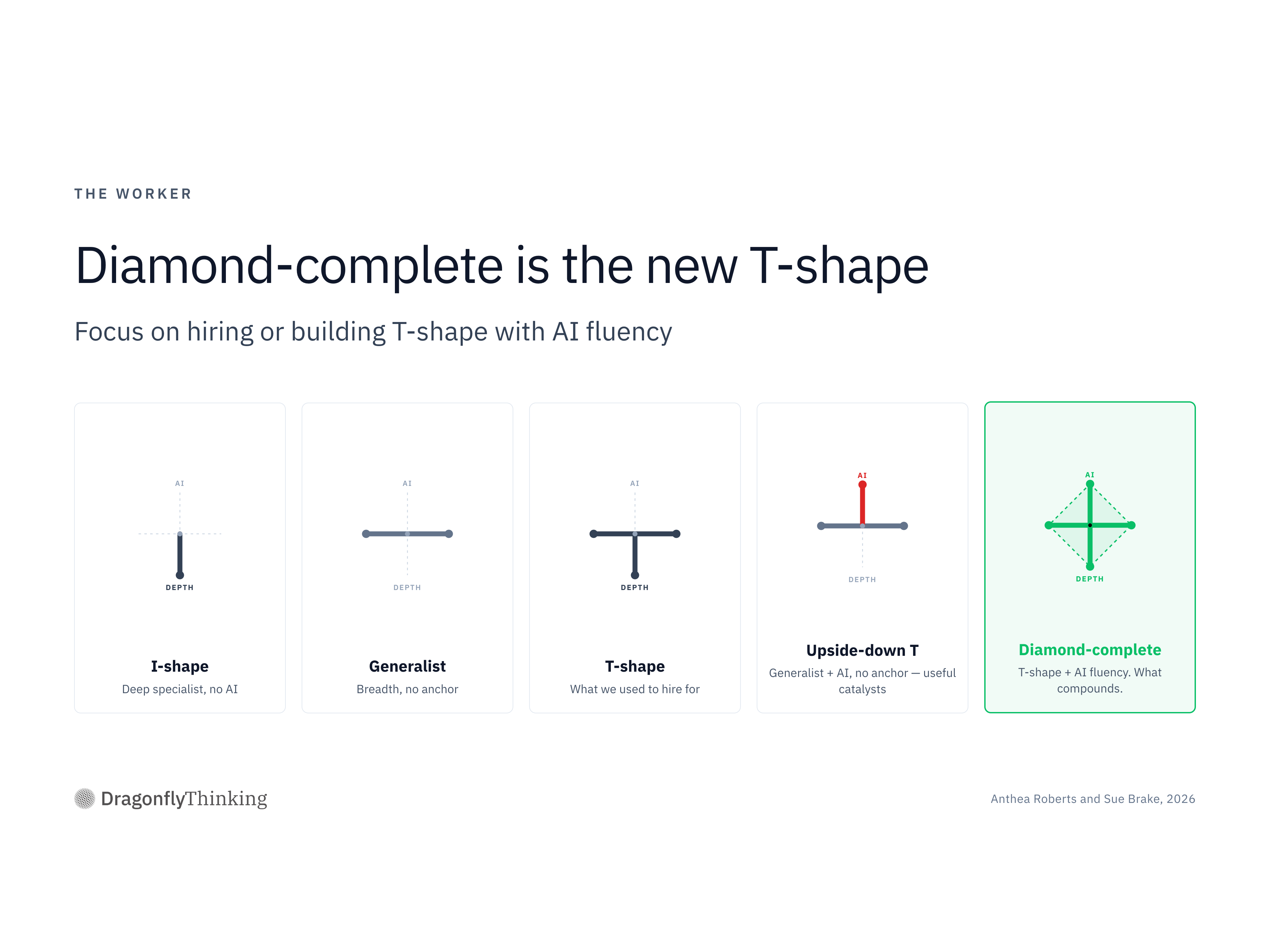
The I is pure depth. A single deep stroke and little width. The specialist who knows one thing thoroughly, like the radiologist, the tax lawyer, or the credit analyst, and stays in their lane.
The dash, for want of a better letter, is pure breadth. Wide but shallow. The generalist who can talk to almost anyone about almost anything: the all-rounder, the connector, the person who sees how the pieces fit without being the expert on any single piece.
The T is both. A deep vertical stroke crossed by a wide horizontal one. The shape goes back to McKinsey's consultants in the 1980s, but it was Tim Brown, who ran the design firm IDEO, who popularised it — and who was precise about what the horizontal stroke asks for: not just knowing a little about other fields, but the curiosity to step into someone else's discipline and stay long enough to be genuinely useful. Depth to stand on, breadth to travel.
Before AI
Each of these shapes came with a clear bargain.
The I-shape's strength was irreplaceability. If you were the best structural engineer in the building, no generalist could do your job, and you could charge for it. Its weakness was brittleness. You saw your own corner clearly and the rest of the workflow barely at all, and if your field shifted under you, there was nowhere else to stand.
The generalist's strength was reach. Most people were specialists boxed inside their silo, so the person who could see across the silos commanded a premium for exactly that. Its weakness was the old jibe: jack of all trades, master of none. With no real depth, there was always a point where you had to hand off to someone who actually knew.
The T-shape was the prize. For about twenty years hiring managers wanted it whether or not they used the word — deep enough to be trusted on something real, wide enough to lead across teams. T-shaped people were the glue that held organisations together. Their only genuine weakness was that they were expensive and slow to grow. You needed years of depth and a temperament curious enough to keep reaching sideways.
After AI
AI has rewritten the bargain, and it has done it in two moves.
The first is a quiet revaluation of the shapes that already existed, and it has crept up on people. Most specialists didn't feel especially threatened at first, for a sound reason: in their own domain, they could still do the work better than the model. What they underestimated was the direction of travel. AI capability has been climbing the ladder of expertise for years: competent first at school level, then undergraduate, then graduate, and now pressing into professional judgment itself. Each year the line moves up, and each year it takes a little more of the ground the specialist thought was safe. The routine parts of expert work go first; the genuine edge-case judgment holds out longest. The pure specialist, with only that one stroke to stand on, is more exposed than anyone expected.
The generalist's reversal is subtler, and it arrives disguised as a gift. Generalists tend to love AI, because it does the very thing they prize: ranging across unfamiliar fields, connecting dots, pulling together a credible view of something they only half knew an hour ago. For a while it feels like a superpower bolted onto their strongest muscle. That's the trap. AI is better at that muscle than any human alive; it has read everything, in every field, that is on the internet. The thing the generalist was paid a premium for is now abundant and nearly free. The tool that felt like an amplifier turns out to be the substitute.
The T-shape comes off best of the three, and is still incomplete. It has depth and breadth both, the two strokes the pure shapes each go without. But AI has added a dimension the T doesn't have, and that is the second move: a new stroke, the upward one. The ability to direct, brief, evaluate, and correct AI well. Not knowing a handful of prompts, but the real skill of setting a task up for a model, judging what comes back, and steering it through to something good. This barely existed as a category three years ago. Now it's the difference between doing your old job slightly faster and doing a different job.
Add the upward stroke to the old shapes and you get new ones. A specialist who adds AI becomes a vertical line: deep and AI-boosted, but still narrow. Faster within their lane, still stuck in it. A generalist who adds AI becomes an upside-down T: wide and AI-fluent, with no anchor underneath. These people move fast, and they make excellent catalysts, the ones who show a sceptical team what the technology can actually do. But with no domain of their own, they can't tell when the AI is confidently wrong, and they compete with the model on exactly the ground where it's strongest.
The diamond
Then there's the shape this piece is named for. Take the T — depth and breadth — and add the upward AI stroke at full length, and the cross closes into a diamond. Depth to know when the model is wrong. Breadth to see the whole workflow it sits inside. Fluency to direct it. We've started calling the people who have all three at full length diamond-complete. In our view, only this shape compounds in an age of AI.
That rising frontier is precisely what kills the old definition of depth, the one that meant "I can do this better than the model." The new meaning is sharper: I know how to direct AI to get better results than it produces by default, and I know where the model fails in my corner, and I catch it before it costs anything. We've written before that expertise and AI skill multiply rather than add, so if either is missing you get very little. The shape is what follows from that. Add breadth on top, and the expert becomes far more rounded, able to work across the whole problem rather than one slice of it.
Domain expertise matters more as AI improves, because the better the model gets, the subtler and harder to spot its mistakes become. A hallucinated citation is easy to catch; a plausible but quietly wrong claim is not. The judgment you need to catch the error rises at exactly the moment the work that built that judgment is being automated away.
We know what it looks like to have deep domain expertise and then learn AI skills — that was a transition we went through ourselves. We are much less clear on the reverse: how someone with AI skills but no anchor goes about building deep domain expertise from scratch, particularly in an AI-enabled world.
If AI now does the work that junior analysts used to cut their teeth on, the document review, the first-pass models, the grunt work, where does the next generation of senior judgment come from? That junior work was never only cheap labour. It was the apprenticeship: the years of doing the work badly, getting corrected, and slowly building the depth no one can shortcut. Automate it away and you don't just save money; you remove the production line for the very anchor the diamond depends on.
So, what can we do in practical terms? Here are three things you could start on this week:
- Find your anchor. Name the specific corner where you can direct the model to create superior outputs and catch it when it's wrong. If you can't name one, that's the work.
- Grow the upward stroke. Move from letting AI help you write toward creating a plan and having it execute while you direct and check. That shift is the difference between doing your old job faster and doing a different job.
- Protect the rungs. If you lead people, don't let AI quietly eat the apprenticeship. Put juniors, seniors, and AI on the same real problem — junior drafts, AI critiques, senior judges.
AI will keep climbing the ladder. To be diamond-complete, we need to learn how to be tall, deep, and wide. If we do, we can put AI to work on things that matter without feeling threatened by it.
This is part of an ongoing newsletter series by Dragonfly Thinking. If you'd like to receive notifications when a newsletter is posted, join the mailing list to receive content directly to your email.
© Anthea Roberts, 2026
Stay informed
Where AI meets strategic thinking.
New analysis on AI, strategy, and the intersection of both — from the team building tools to make better decisions, not just faster ones.