Learning Agency: Two Processes, Not Just One
I move between universities in the US and Australia, between businesses and government departments, between rooms full of students and rooms full of senior professionals. Everywhere, the same question bubbles up. If AI can do the foundational work, how do young people develop real expertise?
It's a good question. And the anxiety behind it is well-founded.
In my view, the quality of what you produce with AI depends on a formula: domain expertise x AI skill. It is easy to see how domain experts might learn AI skills. But how can AI-enabled young people learn domain expertise if they rely on AI during their foundational years? How will they develop the expertise and judgment to know what is right and wrong, and good and bad, in highly fluent and plausible AI outputs?
In a recent podcast, Bret Taylor — OpenAI chairman, co-creator of Google Maps — said something about AI that really resonated with me: "If you want to cheat on the essay, it's probably the best tool ever to do that. If you're curious and you want to learn more, it's also the best tool for that." The impact of AI is bimodal. Same technology, divergent outcomes. Some people use it to cognitively offload and cheat. Others use it to cognitively extend and learn.
So what separates the people who use AI to shortcut understanding from those who use it to accelerate learning?
Learning agency.
Learning agency is the term I use to describe the disposition to design, engineer, and build your own learning experiences rather than waiting for them to be provided. And in the era of AI, I think this is what separates who develops real expertise from who doesn't.
What does learning agency look like in practice? I've been watching the answer play out in software, as that is where the first real impacts of agents are being felt. There are lots of criticisms of AI-enabled juniors creating AI slop. But some are doing something quite different.
Take Zevi Arnovitz as an example. He's a product manager at Meta with zero technical background — he did music in high school. A year ago, code was, in his words, "the scariest thing in the world to look at." Today, his engineers at Meta ask him to teach them how to do what he does with AI.
Or consider Lazar Jovanovic, a forestry engineer who never wrote a single line of code. He now works as the first professional "vibe coder" at Lovable — an AI tool that builds software from natural-language descriptions — shipping products daily. His design judgment, architectural literacy, and debugging instincts developed in months, through AI, not despite it.
Both appeared recently on Lenny's Podcast, one of the most influential shows on AI, product management, and engineering. Both are building real, revenue-generating software without traditional technical skills. And both are doing something that most people who pick up these tools are not: they are running two processes at the same time.
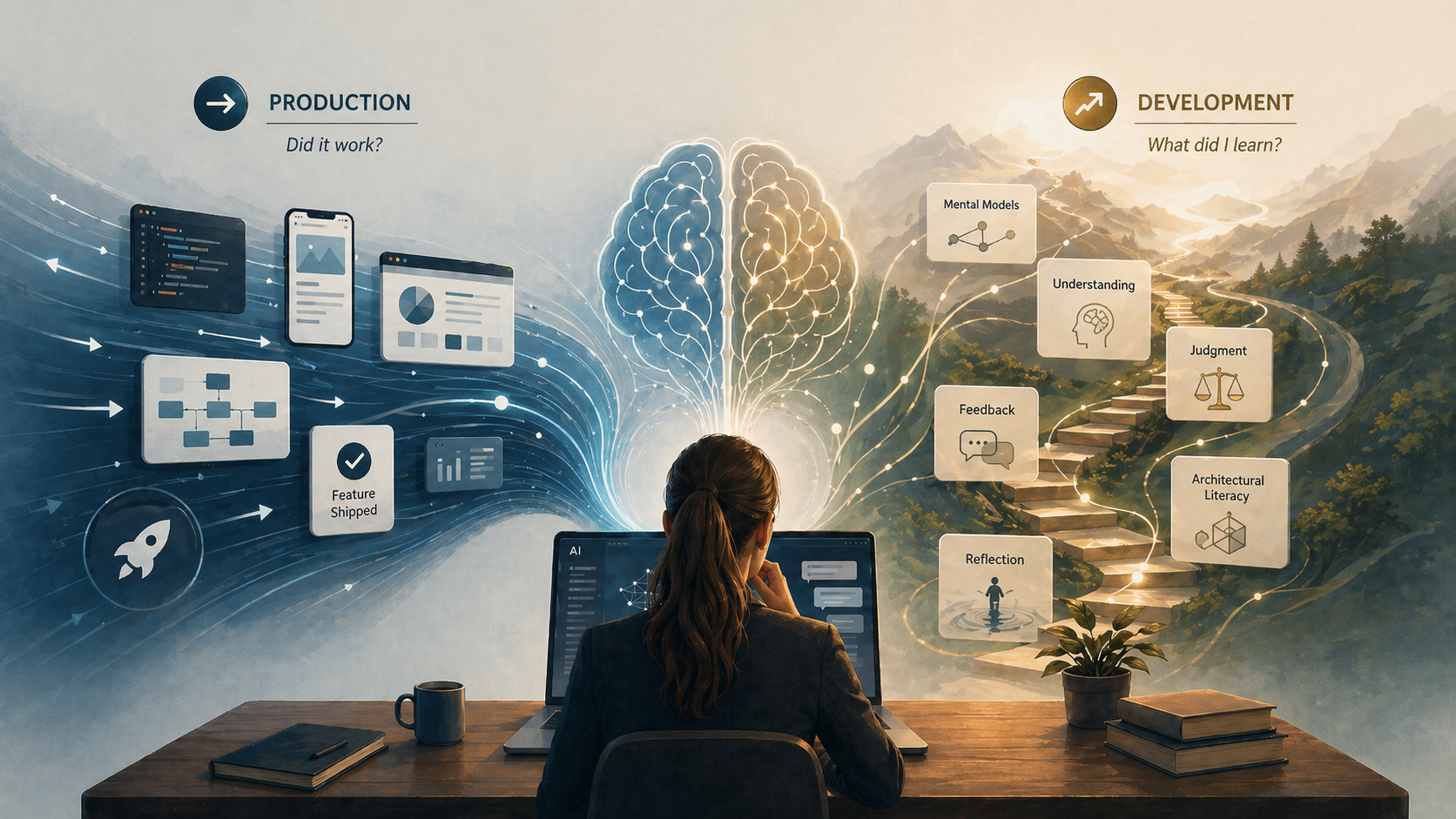
The first process is production. Build the thing. Ship the feature. Get the app working. This is what most people do when they pick up an AI tool, and it works. Something comes out the other end. You are excited about the outcome. You don't need to understand how or why it happened.
The second process is development. Build yourself, not just the thing. Build your own expertise, judgment, and understanding — through the act of building. Most people run only the first process. The people who develop genuine capability are running both, simultaneously, in the same workflow.
The second process shows up in very specific behaviours.
Early in Arnovitz's career, when he was a junior product manager at Wix, he tried to impress his more experienced colleagues by working in isolation and presenting a polished product review. It bombed — wrong format, missed questions, gaps everywhere. But the experience taught him something crucial. His epiphany: "They had zero expectation of me being a 10X product manager, but the expectation of me was being a 10X learner." That reframe — from performing to learning — changed everything for Arnovitz.
Arnovitz didn't just adopt a positive attitude. He turned himself into a learning machine. He built quiz apps to drill himself on product concepts. He mapped each colleague by their specific strength and used each as a targeted mentor: one for product sense, one for methodology, one for systems thinking. He designed his own apprenticeship. And when AI tools arrived, he brought the same orientation: every dollar spent on AI subscriptions was tuition, not cost — "stuff that I'm paying for learning."
Similarly, as a non-designer, Jovanovic didn't know what different design styles looked like. So he used Lovable to build an app that taught him 18 design styles, with prompts to replicate each one. Arnovitz was struggling with segmentation questions for his Meta interview. So he used an AI tool to build a quiz game and drilled himself on the bus to work. Both used AI not just to do work but to manufacture practice for themselves. They weren't outsourcing work; they were insourcing coaching.
After fixing a bug, Jovanovic asks the AI: "How can you help me learn how to prompt you better so that next time I have a problem, we do it in one go?" Then he encodes whatever he learns into a rules file, so the AI applies the lesson automatically next time. He has turned every failure into a system improvement. Arnovitz does the same, but extends it to successes too: "Going back and even when you've succeeded, looking and understanding what you did and what you could have done better is critical." Both are generating feedback that wouldn't otherwise exist.
Arnovitz set up a custom command in his AI coding tool that he invokes whenever something is hard to understand mid-build. The prompt says: "I am a technical PM in the making. I have mid-level engineering knowledge. I want you to explain what we're currently working on using the 80/20 rule." He uses it constantly. He also wrote instructions telling the AI not to flatter him ("I don't want you to be a people pleaser" — after discovering that ChatGPT had told him two completely different programming concepts were "exactly the same" because it was just going along with what he said). The learning happens inside the production workflow, not separate from it. Jovanovic reads the AI's reasoning and explanations "religiously" — not the code, which he doesn't care about, but the thinking behind it. "The syntax is not of my interest," he says. "It's what the agent tells me that matters to me."
Jovanovic tracks his own developmental stages with striking clarity. Stage 1: "Oh, I can build. Wow, amazing." Stage 2, one week later: "Oh, I can build, but I'm not fast enough." Stage 3, two weeks later: "Wait a minute, should I have even built this in the first place?" He knows where he is in his own development. He knows which skills will last (judgment, taste) and which won't (specific techniques): "I'll be wrong on 95% of the things I said today, 3 months from now."
Taylor describes the same pattern with his own children. His son got a 3D printer and wanted to start an Etsy store. He used ChatGPT to learn online marketing — not to have it write marketing copy for him, but to understand how online marketing works so he could drive traffic himself. One of Taylor's kids used ChatGPT's voice mode to quiz herself on Spanish vocabulary on the way to school. When his daughter asked him a coding question, he refused to answer, telling her to ask ChatGPT herself: "I want to teach her how to answer the next 10 questions." His framing: "This is a tool to amplify agency, not to shortcut understanding a topic."
The production process asks: did it work? The development process asks: what did I learn? One person sits with both questions open. The other closes the second one the moment the output looks right.
This disposition is distinct from something we already talk about a lot.
Carol Dweck's growth mindset — the belief that you can get better — was the right insight for its era. Arnovitz read Dweck's Mindset and credits it with changing his life: "I was always with a fixed mindset, and then after reading that, I kind of understood that it was something holding me back." But what these people do goes well beyond belief. They actively construct the conditions for their own learning.
Growth mindset is a belief. Learning agency is an action.
I recognise this pattern because I've lived a version of it myself. I was never a tech person — my kids can confirm this, having spent years helping me figure out the TV remote. But when I started experimenting with AI, I didn't just use it to produce outputs. I watched YouTube videos, read blogs and articles, talked to other people who were experimenting, sat with the tools and got frustrated and learned to direct them better.
When I built Dragonfly Thinking, a start-up that uses AI for strategic analysis, the building was the learning. I wasn't running one process. I was running two. I'm not a software engineer. But I am highly autodidactic and have always charted my own learning journey. I never really had language for this before, but I think it is what I now call learning agency.
This matters because learning agency isn't specific to coding or technology. It's what happens when someone takes ownership of their own expertise development — in any domain, through any medium. It matters now in a way it didn't before because AI is changing how expertise is built across every field.
In a previous newsletter, I wrote about the 0-to-1 / 1-to-10 / 10-to-100 framework — the idea that people relate to AI at different levels. I gave vibe coding as an example of going from 0 to 1 because it allowed people with no engineering experience at all to create an app.
But I hadn't really thought through what it takes to move along that spectrum from 1 to 1+. What separates the person who stays at 0-to-1 from the person who keeps developing? I think learning agency is the variable I was missing. Jovanovic and Arnovitz are concrete examples of people who moved — and the specific behaviours they exhibit show what the second process looks like in practice.
What's interesting is that the expertise they're developing is not the same as traditional software engineering. Neither reads code. Neither understands syntax. What they've developed is what I'd call architectural literacy — a conceptual understanding of structure, sequence, composition, and dependencies. They know what needs to be built and in what order, even if AI handles the implementation details. They navigate software at the level of components and relationships, not lines of code.
This is a different kind of expertise — and it's not unique to software. A junior lawyer who uses AI to draft contracts can develop an understanding of deal structure without having manually drafted every clause. A medical student who uses AI to explore diagnostic pathways can develop clinical reasoning without having memorised every drug interaction. In each case, the expertise is at the level of architecture — structure, sequence, dependencies, purpose — not implementation. And in each case, whether that architectural understanding actually develops depends on whether the person is running the second process: not just producing the output, but learning from the production.
So, when you are using AI, are you running one process or two? Are you only asking "did it work?" — or are you also asking "what did I learn?" When something breaks, do you fix it and move on, or do you debrief with the AI on why it broke and encode the lesson? When something works, do you ship it, or do you also stop and understand why it worked?
The potentially hopeful finding from Arnovitz's experience is that learning agency might be something you can develop, not just something that is innate. He didn't start with this orientation fully formed. He built it — the same way he built everything else.
If that's right, then the first step is simply seeing the second process clearly enough to start running it.
AI is automating many of the tasks through which expertise was historically built. In a world where institutions no longer design your learning for you, the people who thrive will be the ones who design it for themselves.
References
- Lazar Jovanovic, "The Rise of the Professional Vibe Coder," Lenny's Podcast, February 2026.
- Zevi Arnovitz, "The Non-Technical PM's Guide to Building with Cursor," Lenny's Podcast, January 2026.
- Bret Taylor, "Curiosity, Agency, and AI," Glue Guys Podcast, 2026.
- Carol Dweck, Mindset: The New Psychology of Success (Random House, 2006).
© Anthea Roberts, 2026
Stay informed
Where AI meets strategic thinking.
New analysis on AI, strategy, and the intersection of both — from the team building tools to make better decisions, not just faster ones.