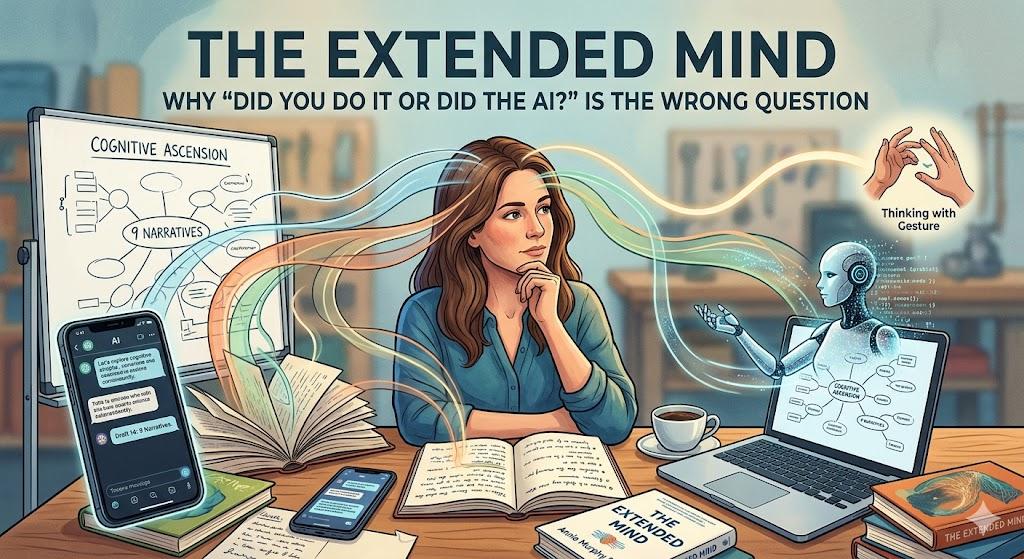
The Extended Mind: Why "Did You Do It or Did the AI?" Is the Wrong Question
Two weeks ago, I was working with one of my colleagues at Harvard on a new research project we were doing together. I had come to the table with a lot of the initial background research done and three first drafts of different ideas I wanted us to discuss. "But did you draft them, or did the AI do that?" He asked me.
The question didn't make me defensive. It made me genuinely confused. Because as somebody who works closely with agentic AI, almost everything about it is co-created. The idea that there's a clean line — my thinking on one side, the machine's on the other — doesn't match how any of it actually works. And what does "drafting" a paper mean in an AI world?
I'm used to hearing concerns about people relying on AI on the basis that "writing is thinking." For many people, their thoughts only become clear as they wrestle with them through the writing process. But to me, writing isn't necessarily thinking, though it can be. To me, thinking is thinking. And I've never done it just in my own head by myself.
I think best verbally — my first drafts are oral. I always have. There is a reason that I didn't love writing essays at school, but I was happy to travel around the country and world doing debating. I think with books. I think with other people. I scribble notes in margins. I draw diagrams in books and on walls. I explain my ideas to colleagues and students and listen to their thoughts and feedback.
Now I have brought AI agents into my thinking process. And I think that what I've been doing with AI is just another step in a very long process of thinking with tools and other minds. So when people ask the question "did you write it, or did the AI?", my reaction is that we both wrote it and that the framing of the question is wrong.
The attribution question assumes something specific about what thinking is: that it's a solo performance. One brain, working alone, producing the output. If the output is good, that brain deserves credit. If a machine was involved, the thinking was outsourced and the credit is contaminated.
This assumption runs deep. It's in how we evaluate students, how we assess originality, how we assign authorship. So does the cheating debate I wrote about in an earlier newsletter. The whole frame depends on a boundary: there is what happens in your head, and there is everything else. Everything inside the boundary is thinking. Everything outside is assistance, offloading or cheating.
But what if that boundary never made sense even in a world before large language models?
A few years ago, I read Annie Murphy Paul's The Extended Mind. Paul is a science writer who spent years reporting on research in embodied, situated, and distributed cognition. Her argument, grounded in decades of work by cognitive scientists and philosophers, is that the mind does not stop at the skull.
We think with our bodies. The walk that unlocks an idea you couldn't find sitting at your desk. The gesture you make with your hands when you're trying to explain something you don't yet have words for — and how making that gesture actually helps you find the words.
We think with our surroundings. The whiteboard covered in Post-it notes. The way you rearrange physical cards on a table to see a pattern you couldn't see in a list. The particular room where the good ideas come, and how it stops working if you move. The desire to write with a particular pen in a particular notebook.
We think with our relationships. The colleague who asks the question that reframes everything. The study group where you understand something by explaining it to someone else. The collaborator whose challenge makes your argument sharper than it would have been alone. The friend you call up because you know you discussed a particular paper and now you can't remember who wrote it or where to find it.
When I first read Paul, I loved it because it captured something for me about the way I think with my extended mind. But if thinking has always extended beyond the brain, into bodies, spaces, and relationships — then the question "did you do it or did the AI?" rests on a model of cognition that was never accurate. We don't ask a violinist "did you play that or did the violin?" The question doesn't make sense because the music only exists in the relationship between them.
Paul's book draws heavily on the work of Andy Clark, a philosopher at the University of Sussex who coined the term "the extended mind" with David Chalmers in a 1998 paper that changed philosophy of mind. Their argument: when an external resource plays the same functional role that an internal cognitive process would play, it IS part of your cognitive system. Not metaphorically. Literally.
Clark has spent the last twenty-five years developing this idea. In May 2025, he published a paper in Nature Communications that directly addresses AI. His framing: we are, and have always been, "natural-born cyborgs" — hybrid thinking systems that constantly incorporate non-biological resources. New technologies don't replace our thinking. They create what he calls "delicately interwoven new wholes" — brain, body, and world working together, each adapting to what the rest offers.
Clark points out that we've had this panic before. In Plato's Phaedrus, written around 370 BC, Socrates warned that the invention of writing would destroy human memory. People would think they knew things when really they'd just written them down. He was right that writing changed memory. He was wrong about what that meant.
Writing didn't make us stupider. It did make our memories worse. But it also made a different kind of thinking possible — thinking that was more complex than an individual could hold in their head. And writing this complex thinking down also meant that thinking could be passed more easily down the generations, so one person's thought could be built more easily on top of another's.
The same fears, 2,400 years apart.
One finding from Clark's paper stayed with me. A study of human Go players found that following the emergence of superhuman AI playing strategies, human players showed more novelty in their own moves — not less. They didn't become copies of the AI. They broke past centuries of received wisdom and began exploring parts of the game that had been invisible to them. The AI didn't replace their creativity. It extended it into territory they couldn't have reached alone.
When I look at my own practice through this lens, what I see is extension.
I have created the agents I interact with by encoding my cognitive frameworks and methodological approaches into them and their skills. I supply the topic I want us to investigate and give directions about what background reading to do. I lay out the thesis I think I want to make before I start talking to the agents about how to develop it and to push back against it. I think best verbally, so I do the first draft in oral format. I extensively edit and reframe — I am currently on version 14 of my essay on AI and competing narratives.
This is my workshop. The AI is one of the tools in it, alongside the whiteboard, Whispr Flow for voice translation, the colleague I message at odd hours, the walk I take when I'm stuck. I've shaped the tools to carry my frameworks. I direct where we go. I asked the AI agents to undertake research on different topics, including foraying into areas with which I'm less familiar. I have iterative dialogues back and forth where I test out different ideas and get reactions from AI agents. The thinking happens in the interaction between all of these things.
Working with AI allows me to practice three forms of cognitive extension.
-
Ascending — operating at a higher level of synthesis than a single mind can sustain. Nine competing narratives about AI, their champions, their evidence, their interactions, tracked week over week. No human holds all of that simultaneously.
-
Exploring — pushing across disciplinary boundaries that my training doesn't span. Labour economics, geopolitics, AI safety research, philosophy of mind — the problems worth studying don't respect disciplinary lines, even if our educations do.
-
Collaborating — thinking with a partner who can be directed to challenge me from perspectives I'm inclined to overlook.
All three map directly onto Paul's framework — thinking with the space of ideas, thinking with experts, thinking with peers — except the tool now spans more domains and is available at any hour.
Yet there is a real complication here.
A paper published in Frontiers in AI in 2025 — titled "The Extended Hollowed Mind" — warned that AI can simultaneously extend cognition and cause cognitive atrophy. The authors point to a study showing up to a 55% reduction in cortical activity during AI-assisted writing, accompanied by memory impairment. The underlying study calls this "cognitive debt" — short-term efficiency purchased at the expense of deeper encoding.
I take this seriously. But I think the framing misses something that becomes obvious if you think about how teams already work.
My husband leads legal teams. He directs the strategy and assigns writing tasks to juniors. They're the ones who read the underlying cases and produce the first draft. He interrogates those drafts, revises them, and has enough background to know whether the research sounds right or is off. He sends them back when it isn't. He asks probing questions and requests more research or revised outputs. Back and forth they go. When the draft is in good enough shape, he is likely to take his own red pen to it to ensure the final edits are in. When he is happy with the final output, he signs off on it. Literally.
You wouldn't ask him, "Did you write the brief, or did the junior write the brief?" That framing just doesn't make sense for this sort of collective process. You'd say "the team" wrote the brief — it was a collective effort, the way most serious professional work is. And yes, he probably has less recall on the actual quotes and case citations than if he were the junior doing the underlying research himself. But I wouldn't describe that as cognitive atrophy. He has ascended up the scale to do the directing, the coaching, and the editing. That allows him to be more acutely aware of things at that strategic level, even if he is less aware of all of the detail at the more tactical level.
The difference now is that the teams aren't just humans working together. They're humans and AI working together.
The real question isn't whether you know less at one level. It's whether you're genuinely operating at the higher level — or just sitting back while the AI does both. That's a question about technique and practice, not about the technology itself. Going forward, I suspect we're going to see cognitive gym bunnies and cognitive couch potatoes. The technology is the same. The outcomes diverge based on how you use it.
But there's a second question that may matter even more: how do you develop the expertise and taste to direct agents well in the first place? My husband can smell when something is off in a brief because he spent years doing the granular work himself. I can direct AI agents effectively because I have decades of research training to draw on. What happens to the people who never build that foundation — the students who reach for AI before they've learned to construct an argument, the junior analysts who skip the hard apprenticeship years? That's a question I'm exploring in a forthcoming piece on the training crisis, and I think it may be the most consequential challenge the extended mind faces in an AI world.
If I had to distil this into something practical, it would come down to asking different questions.
Instead of "did I do it or did the AI?" — ask whether you're thinking better with this tool than without it. If the answer is yes, the attribution question is the wrong question.
Instead of worrying about whether AI is real thinking — ask whether you're extending or offloading. Extension means you're still in it — directing, questioning, editing, pushing back. Offloading means you've stepped out. The difference isn't about the tool. It's about whether you're still the musician or you've handed the instrument to someone else and left the room.
And recognise the extensions you already use. Notebooks, whiteboards, colleagues, walks, teams. You have never thought alone. AI is not a break from human cognition. It's a capability expansion in a practice you've been doing your whole life.
The extended mind tradition says the attribution question was always the wrong one — not just for AI, but for thinking in general. Cognition has never been a solo performance. It runs through our bodies, our environments, our tools, our relationships. Now it will run through AI and we don't have proper language for this form of co-creation yet. The question isn't whether I did it or the AI did it. The question is, what did we create together that neither of us would have created alone?
© Anthea Roberts, 2026
Stay informed
Where AI meets strategic thinking.
New analysis on AI, strategy, and the intersection of both — from the team building tools to make better decisions, not just faster ones.